AI data centers should return value into the knowledge system
This week I had the opportunity to attend Datacloud Global Congress through their Talent in Tech program.
As far as I could tell, I was in a somewhat unusual position. Among thousands of participants from the data center, cloud, energy, investment and infrastructure sectors, I was there primarily as a researcher.
That made my experience especially interesting.
I came away with the impression that the data center debate in Norway is often trapped between two simplified positions. On one side, data centers are framed as the next chapter in Norwegian industrial history: renewable energy, digital infrastructure, jobs, AI and regional development. On the other, they are framed as power-hungry real estate projects with limited local value and large foreign beneficiaries.
I think both perspectives miss something important.
The question should not simply be whether Norway should build more data centers. The question should be which kinds of data centers deserve Norwegian power, land, political support and public trust.
For AI infrastructure in particular, I believe the answer has to involve research. Not as a decorative add-on, but as part of the social contract.
Compute is becoming research infrastructure
Large technology companies have shown how powerful the combination of compute, talent and long-term research environments can be1. Their AI labs are not powerful only because they have smart people. They are powerful because they combine smart people with access to enormous computational resources, engineering capacity, data infrastructure and long-term institutional focus.
Academic research has a different strength. It has independence, openness, peer review, public legitimacy and a responsibility to ask questions that are not always aligned with short-term commercial incentives.
But academic research increasingly has a problem: too little access to compute.
This matters because compute is becoming one of the defining resources of modern AI. Access to advanced hardware is increasingly difficult, especially for actors outside the largest technology companies. If Norway and Europe want to build meaningful AI capacity, we need to think carefully about how infrastructure, research, industry and public value are connected from the beginning.
A data center that only happens to be located in Norway is not necessarily Norwegian AI capacity in any deeper sense. The more interesting question is whether it builds capabilities in the society hosting it.
A positive example in the north
This is why the recent agreement between Aker Nscale and UiT The Arctic University of Norway is so interesting.
In connection with the data center being developed in the north, Aker Nscale is committing NOK 100 million over ten years to strengthen AI competence and research in the region. The agreement includes an innovation center in Narvik and a new interdisciplinary AI research center at UiT.
That is a substantial commitment, and it deserves recognition.
It shows that an AI data center can be more than infrastructure placed in a region. It can also become part of a regional knowledge system.
At the same time, it points to the next important question: how do we design these projects so that research is not only funded around the infrastructure, but structurally connected to it?
Funding research is important. But in AI, the core bottleneck is often not only funding. It is access to hardware, data infrastructure, technical expertise and long-term compute capacity.
This distinction matters.
A data center project can support research financially without necessarily giving researchers access to the infrastructure that makes modern AI research possible. That does not make the support insignificant. On the contrary, it is valuable and should be acknowledged. But it also shows why the next generation of AI infrastructure needs more precise models for connecting commercial infrastructure with independent research.
This cannot be a vague public-good experiment
From a developer or investor perspective, this is where things become difficult.
It is easy to say that research should be built into AI infrastructure. It is harder to design that in a way that keeps the project commercially viable.
Developers need customers; investors need confidence; anchor tenants need predictable capacity; hardware is scarce; GPU clusters are expensive; large customers often require guarantees around availability, security, support and performance. Projects at this scale cannot be run as vague public-good experiments.
That is precisely why the research component has to be designed clearly from the beginning.
The point is not to make AI data centers less commercial. They have to be commercially viable. The point is to design them so that profitability and public value are not treated as opposing goals.
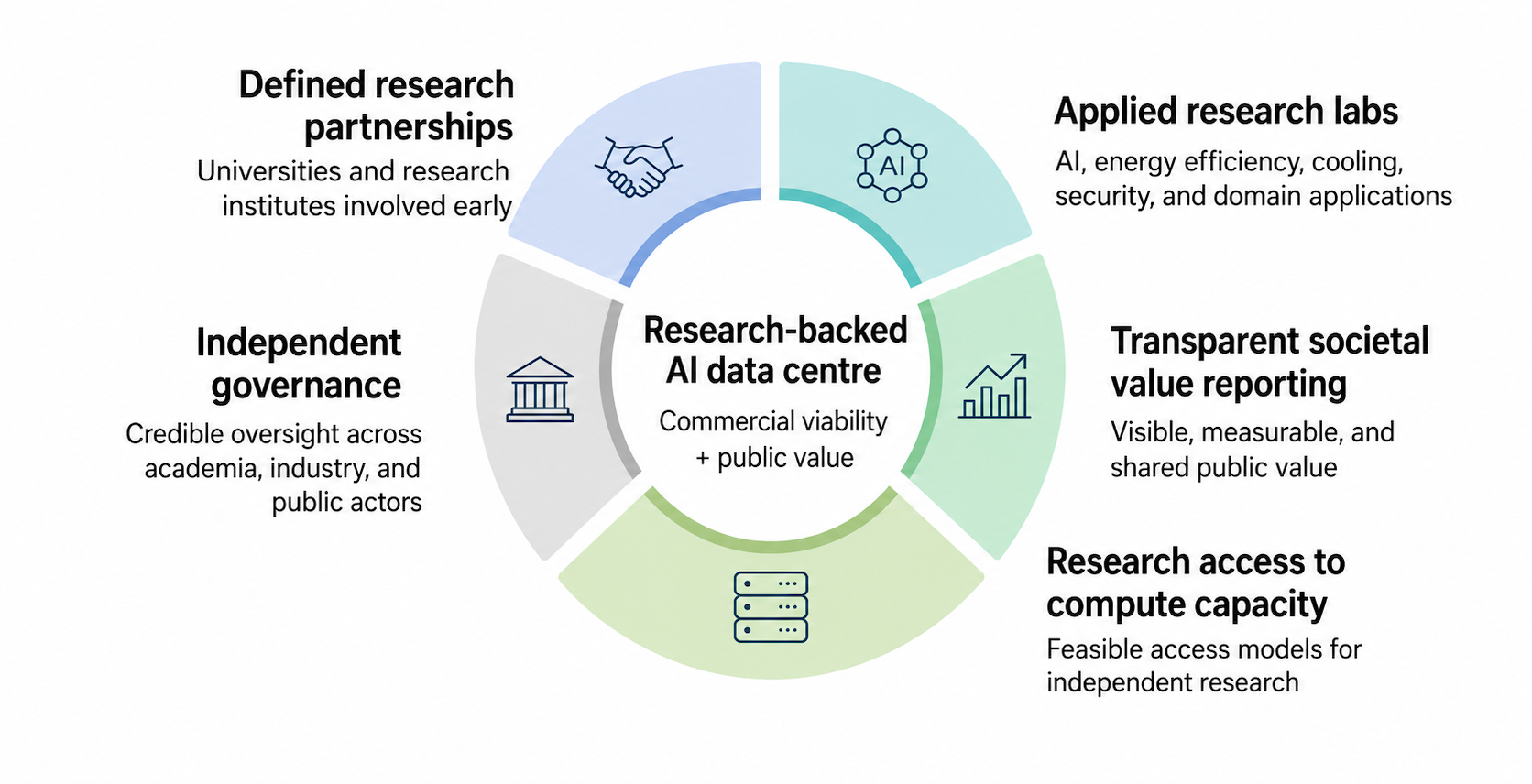
A serious model could include several components:
First, defined research partnerships. Universities and research institutes should not only be invited after the project has been planned. They should be involved early enough to shape research agendas around AI, energy systems, security, sustainability, health, language technology and scientific computing.
Second, applied research labs connected to the infrastructure. These could focus on energy-efficient AI, workload scheduling, cooling, heat reuse, secure AI infrastructure, scientific machine learning and domain-specific applications in health, climate, energy and public services. In this model, research is not only a public-good obligation. It can also improve the technical and commercial quality of the infrastructure itself.
Third, transparent societal value reporting. If data centers claim to create public value, that value should be made visible and open to scrutiny. How much competence was built? How many students, PhDs, engineers or startups benefited? What research outputs came from the collaboration? What were the energy impacts? What was the local value creation? What was the opportunity cost?
Fourth, mechanisms for research access to compute capacity where feasible. This does not necessarily mean giving away prime capacity for free. Commercial customers may need guaranteed priority, while researchers may be able to use lower-priority queues, off-peak capacity, co-funded allocations or nationally governed access schemes. The details matter, but the principle is important: if compute is central to AI capability, access to compute must be part of the conversation.
Fifth, independent governance. If research access and societal value are part of the project’s legitimacy, they should not be governed purely as marketing. Some form of independent advisory structure, involving academia, industry and public actors, could help allocate research capacity, evaluate outcomes and maintain credibility.
A licence to operate
The data center industry has a reputation problem. But I do not think this can be solved by communication alone.
It has to be solved by building projects whose value is visible, measurable and shared.
For developers, this should not be seen only as a burden. Research integration can reduce political risk, strengthen local legitimacy, attract talent, support public-sector collaboration, improve the ESG story, and differentiate serious AI infrastructure from generic power-intensive real estate.
In that sense, research can become part of the licence to operate. Not in the narrow legal sense, but in the broader social sense: the reason society accepts that scarce power, land and political attention are allocated to such projects.
Beyond location-based sovereignty
Norway and Europe need to think carefully about what technological sovereignty actually means.
A data center located in Norway is not automatically sovereign in a meaningful sense. It may use Norwegian power and land, but the strategic value depends on who controls the infrastructure, who gets access to it, what competence is built around it, and whether it strengthens our ability to conduct independent research and develop technology in the public interest.
A sovereign AI data center should not only be sovereign by location, ownership structure or energy source. It should be sovereign by the capabilities it builds in the society hosting it.
For me, this is the most interesting future for Norwegian AI infrastructure.
Not just hyperscale or neocloud capacity located in Norway, but infrastructure that makes Norway and Europe more scientifically capable, technologically sovereign and democratically informed.
If AI data centers are to use scarce power and land, they should not only extract value from Norway’s energy system.
They should also return value into Norway’s knowledge system.
-
Major AI providers have research groups with impressive resumes such as Meta Research, Google AI, etc. ↩↩↩